

Using “Parts” To Adjust A Recipe
I’ve learned that knowing how to adjust a recipe is truly a helpful and valuable skill. It allows you to update old recipes, re-size recipes, and invent new recipes, all things you often do when you have a make-your-own kind of lifestyle. And I also think the most necessary concept in doing this is to understand how to use “parts”. So that’s what we’ll be looking at here today, and hopefully making it simple and easy to understand too!
What are Parts in a recipe?
When we look at a recipe, we’re not only looking at instructions for WHAT goes into the recipe (the ingredients) but also HOW MUCH to put in our recipe (the measurements). The measurements in a recipe can be different units – teaspoons, tablespoons, cups, etc.
To think in the concept of “parts” in a recipe, you need to think in terms of just one consistent unit of measurement. This unit of measurement will determine the size of the recipe.
When I adjust a recipe using parts, I often think of it as “this is the size scoop I will be using”. Let’s look at an example.
Let’s say we have our Make-Believe Spice Blend that is 1 teaspoon garlic powder, 2 teaspoons pepper, and 3 teaspoons salt. In this example it’s pretty easy to see that our unit of measurement, (our size) or our “part”, or our “scoop”, is the teaspoon. We can also see that we are doing 1 part garlic powder, 2 parts pepper, and 3 parts salt.
NOW, if we want to make a bigger batch of our Make-Believe Spice Blend, all we have to do is change our unit of measurement. Pick a new size scoop! If we use our tablespoon, we’ll have a batch that’s about triple the size of the original recipe. If we want just an itty bitty batch, we can use our 1/4 teaspoon. As long we keep our ratios in this example to 1 Part – 2 Parts – 3 Parts, we’ll still have the same recipe, just in different sized batches.
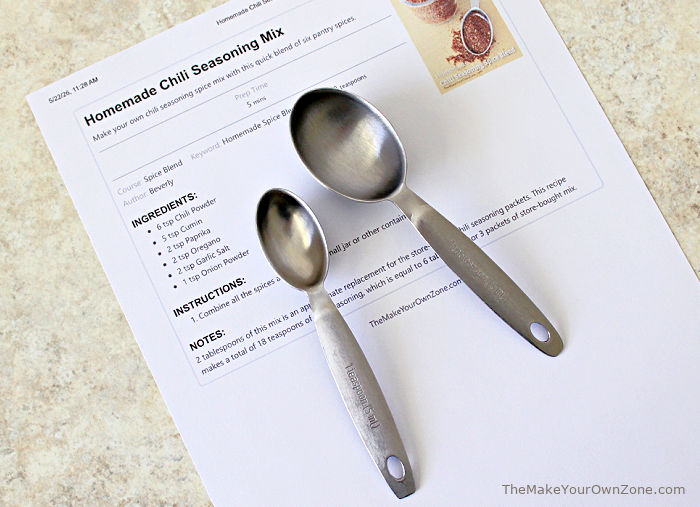
If a recipe already has a consistent measuring unit (a part) for each ingredient, then it’s pretty easy to adjust by just picking a new size scoop. My homemade chili seasoning is an example of this type of recipe.
But recipes usually have lots of different measurements!
OK, that was a simple example to get us started. But most recipes don’t just have one consistent measurement throughout. You’ll see teaspoons, tablespoons, cups, etc. What do we do then?
The first step is to look at the current recipe and decide what unit of measurement will be your “part” based on if you are adjusting a recipe smaller or larger. This next example is how I adjusted my Chocolate Wacky Cake mix to make it just a little smaller.
In my first review of the recipe, I could see that using a 1/2 cup as the part was how the original recipe was laid out. To make it a bit smaller, I changed my part to a 1/3 cup. Here’s a graphic below to show how that all worked out:
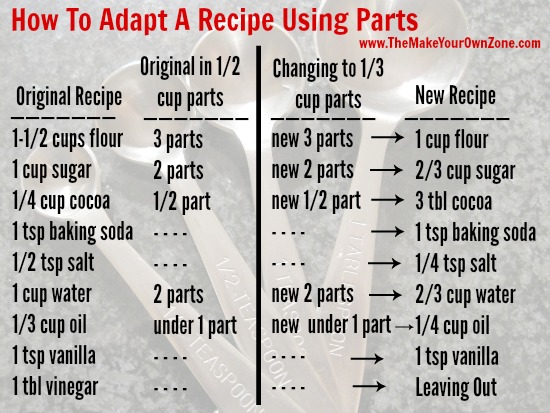
One thing to remember is that things don’t always calculate out perfectly. Sometimes you have to roll with it and enjoy the process. A few “less than perfect” measurements from the above example are . . .
The 1/2 part of cocoa – What is half of 1/3 cup? Well, there are just a little over 5 tablespoons in 1/3 cup, so cutting that in half would be about 2.5 tablespoons. I decided to round up to 3 tablespoons for a little more cocoa goodness.
The little less than 1 part of oil – What’s just a little less than 1/3 cup? I decided it was 1/4 cup and went with that.
The teaspoons – Because the teaspoons would be such a small ratio to the parts I was using (1/2 cup and 1/3 cup) I decided to just leave the teaspoon of baking soda and teaspoon of vanilla as they were, and just cut down on the salt a little bit.
And the vinegar? Because I was downsizing my cake recipe so I could use it as a component of another dessert recipe, I decided just to leave the vinegar out.
And if you really don’t want to do too much math, just go with the “scoop” approach. For instance in this new recipe, when I translated the 3 parts of flour to become 1 cup, I could have also just used my 1/3 sized measuring cup as a scoop and filled it with flour three times. That’s how the concept of parts truly works!
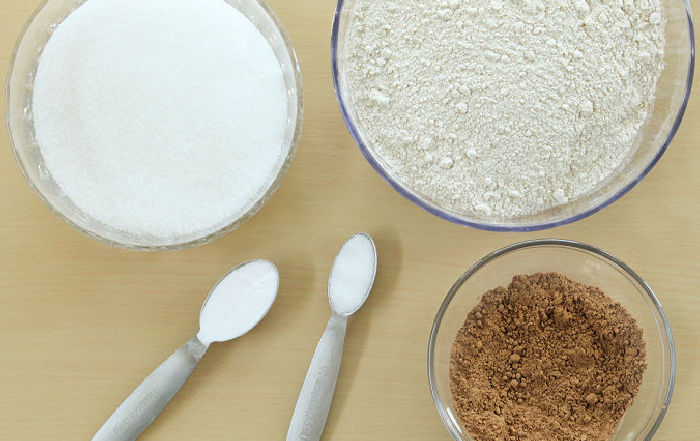
Understanding “Parts” helps you create recipes too!
And finally, here’s another way the concept of Parts has been helpful for me. When I go online in search of a new recipe I want to learn to make, I end discovering lots of recipes that all have just a few little variations that make them different. Sometimes it leaves me wishing there was just one consistent recipe everywhere I looked.
When this happens, my usual strategy is to get out a piece of paper and start writing down some of the ingredient lists I’ve found side-by-side so I can start comparing. I usually write down at least 4 or 5 recipes, sometimes more. Once I have these different versions written down side-by-side, I can almost always start seeing a common thread or some consistent pattern.
For instance when I first made my homemade Kahlua I used this strategy and discovered that the main thing they almost all had in common was equal parts of water and vodka, and the main variable was how much sugar each of the different recipes used. From there, I could see my way clear for “My Idea” in a size that worked best for me.
Summing it all up
So to sum up, here are the important concepts:
~ Using parts means thinking in terms of just one consistent unit of measurement. This unit of measurement will determine the size of the recipe.
~ Look at the current recipe you wish to re-size or adapt, and find what that consistent unit of measurement could be. This will help you see what the “parts” are in your current recipe.
~ Pick your new new unit of measurement and use that as your new “scoop” when measuring out the parts.
So hopefully this can help a bit for others out there that like to create, tweak, and adapt their recipes. Go forth and make-your-own adjusted recipes that are perfect for you!

this was super helpful! I never understood this concept and you explained it a way I could easily understand. Thank you very much!
I’m glad I could help Ana!