

Things You Should Not Mix When Making Homemade Cleaners
Making homemade cleaners can be a great money saver and a fun creative outlet too. There’s a satisfying feeling to getting some ingredients out of the pantry and with just a bit of measuring and mixing, you’re able to make what you need for your household cleaning.
But that being said, there are definitely some things should you NOT mix together when making homemade cleaners. Certain ingredients can create ineffective gunk at best, and toxic fumes at the worst.
So creativity is good, but it needs to be balanced with your best research if you’re going to try to create your own cleaning mixtures, and we’ll be taking a closer look below at which combinations can cause problems.
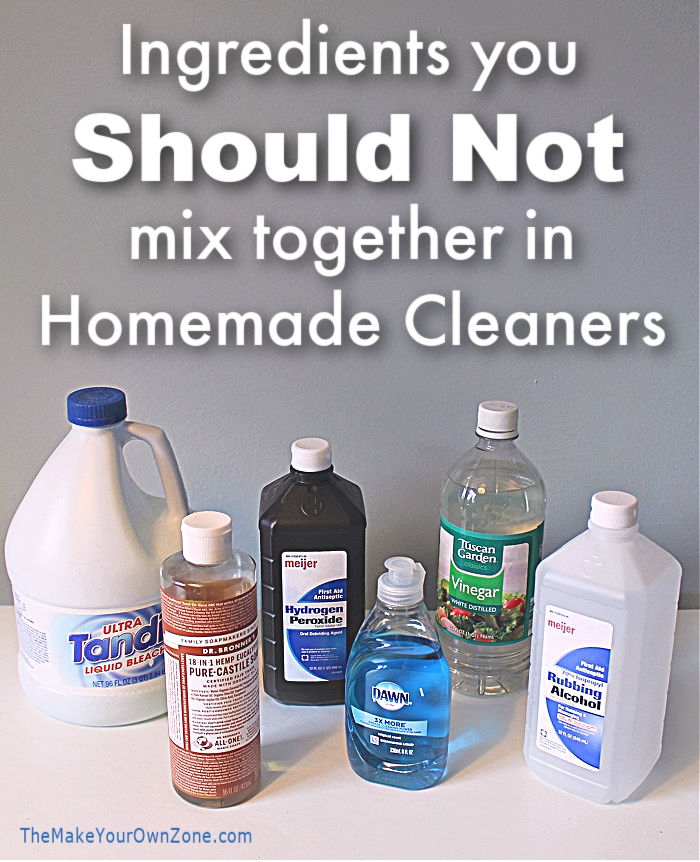
Only Mix Bleach With Water
The first thing we’ll be talking about is bleach. Bleach doesn’t show up much in green cleaning recipes but nevertheless, it can create some of the worst combinations so it needs to be discussed. Bleach should only be mixed with water if using it for cleaning purposes. If mixed with the wrong thing, bleach can cause toxic fumes that can greatly irritate and do damage to skin, eyes, and the respiratory system. For instance:
Bleach + Ammonia = Chloramine Gas Inhaling the vapors of this toxic gas can give you shortness of breath and chest pain, as well as throat burns and other respiratory damage.
Bleach + Vinegar = Chlorine Gas Again, a gas with bad vapors causing coughing and burning, watery eyes and possible lung and eye damage.
Bleach + Rubbing Alcohol = Chloroform Another lung irritant and vapors can cause nausea and dizziness, as well as damage to lungs, eyes, skin, and the nervous system
And finally, here’s one that may surprise you – –
Bleach + Dish Soap = Possible Toxic Fumes Dish soap? Really? Yes, it can happen! I wrote about this a bit more in my post about combining homemade laundry soap made with Dawn with bleach in a laundry load (which I actually decided was OK even though some disagreed with me). My research on this showed that some dish soaps contain an ammonia based chemical and can create the same problem with fumes as the bleach/ammonia combo described above. I know some folks may be in the habit of putting a bit of bleach in a sinkful of soapy water to thoroughly clean dishes, but this is not a good idea. In fact, here’s an excerpt from an email a reader sent me (after reading my post about Dawn dish soap and bleach) describing her experience:
“I used Palmolive dish soap and bleach in the shower. I had put the dish soap on to soak and then thought I would use some bleach to clean the shower handle. When the two mixed, I began to have burning in my nose and eyes. I ran out of the room to my computer and the first thing that came up was “Make your Own Zone” (my new favorite website!!!) I knew I could not mix bleach and ammonia, but I didn’t understand the problem with dish soap, until I read your blog. Well, I opened the window, turned on a fan, and obviously, I’m still alive. I did end up washing out my nose and throat because the mixture really did create some potent fumes. I just wanted to say “thank you” and keep up the good work.”
So when it comes to bleach and homemade cleaning, you should only mix it with water – nothing else!
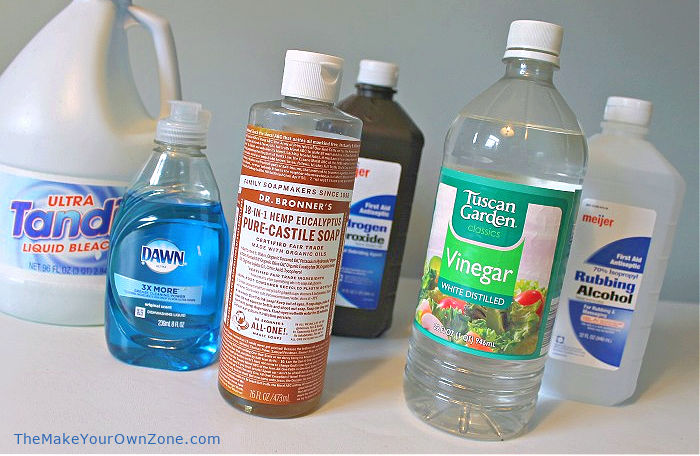
Not Everything Mixes Well With Vinegar
Vinegar is a great all purpose cleaner and there are all kinds of homemade cleaning recipes that include vinegar in the ingredient list. BUT vinegar is an acidic liquid and doesn’t always combine well with other things. Of the three combos we’ll look at next, one can create a corrosive irritant while the other two just create questionable cleaning.
Vinegar + Hydrogen Peroxide = Peracetic Acid It might be tempting to mix these two natural disinfectants together but doing so creates peracetic acid, a corrosive acid that’s an irritant to skin and eyes. Instead you can use them separately as a very effective homemade disinfecting duo. Just don’t put them in a spray bottle together!
Vinegar + Baking Soda = Mostly Water & Sodium Acetate There’s nothing dangerous in this mixture because vinegar and baking soda basically cancel each other out, the one being acidic and the other alkaline (or base). But most advice says there’s not much benefit in this combination either. After all the fizzing is done, you can be left with a solution that’s rather like salty water. Now, I carefully avoided mixing these two based on this chemistry BUT a while back I forgot my rule and made a homemade soft scrub with baking soda and lemon juice (another acid that created fizzing) and it’s one of my most effective cleaners on soap scum!
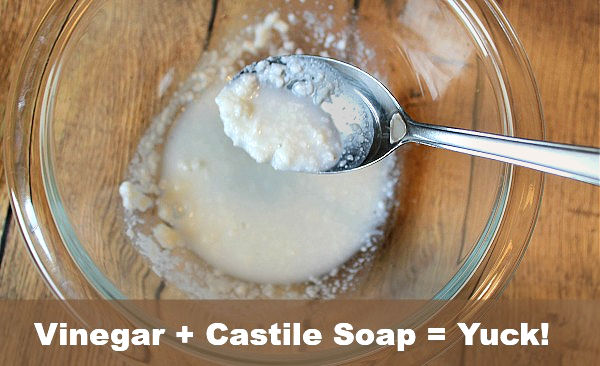
Vinegar + Liquid Castile Soap = Oily & Lumpy This is another mix that’s not dangerous, but not useful either. Once again, these two ingredients are cancelling each other out (one being acid and the other base). Vinegar and castile soap are two very popular green cleaners but if you add vinegar to liquid castile soap, it will immediately turn a cloudy white color and be filled with lumps. The soap will break down (or become unsaponified) and will become oily and curdled looking and will no longer be useful for cleaning.
Careful Creativity
There’s still some room for creativity when mixing up your homemade cleaners (for instance trying different essential oils in your cleaners) but you should always take care, with bleach and vinegar especially. I try to practice “careful creativity” and have found that many homemade cleaners can be water-based with just a few carefully chosen ingredients added in. I would encourage you to always do your due diligence and research to stay safe when mixing up any new homemade cleaner idea.

I just mixed up a batch of my usual DIY cleaner 1 cup distilled water, 1/2 cup vinegar, 1/cup 70% isopropyl alcohol and a few drops of dawn dish soap and for the first time the mixture went cloudy with white flaky floating particles in it..I normally use boiled cooled tap water but had distilled water on hand for humidifier so tried using it instead why would this happen? The ONLY change was the distilled water is it still OK to use? Help Please!
I don’t know where the idea that vinegar is very useful for cleaning came from. It won’t do a thing to any surface that is oily or greasy, like anything in a kitchen. It won’t clean soap scum either. About the only cleaning task it is good for is removing a very light coat of mineral deposit or when hot it can clean the minerals out of a coffee maker.
It’s not so much an idea as it is science. Lime from hardwater is of course calcium carbonate (alkaline). I’ve been able to remove minerals that were 1/4 thick by the spray and wipe every 5-10 minutes.
For soap scum/ grease mix: 50/50 vinegar and dawn, works like a charm.
sidebar: NEVER use baking soda and Palmolive. Very toxic; it will ruin your day.
I’ve been mixing oxy clean dish soap & vinegar & trying to find out if it’s safe .. I mix a tablespoon of the oxiclean dish soap to 2/3 vinager & 1/3 water in a spray bottle and I spray it on everything I clean ..
Oxyclean is strong peroxide and as cited above should not be mixed with vinegar.
What about palmolive and SOS pads? Recently used a SOS pad on a really greasy pan. Added palmolive since it was extra greasy and a really strong ammonia smell occured. Do you know what chemicals are used in the SOS pads?
SOS pads do have some soap in them but I checked the Material Data Safety Sheet for this item and under “Section 10 Stability and Reactivity” it says None Known under Reactivity. Not sure why you had an ammonia smell. https://www.thecloroxcompany.com/wp-content/uploads/s.o.ssteelwoolsoappadsjw2014-10-23.pdf
Do not store so pads or steel wool near batteries. As it can create fire.
My husband boiled dish washer pod with lemon juice. Smelled like sodium hydroxide.
Wow, how interesting, I was going to mix the dawn and vinegar to clean my shower. Then I found “Things you shouldn’t mix together” I’m a bit upset that Pinterest allows them to advertise chemicals that can harm us.
HI- I still don’t see where it says not to mix vinegar and dawn. Did I just overlook it somehow?
Around 5 months ago I looked on Pinterest to see what natural alternatives there are for cleaning products and came across (White distilled Vinegar, baking soda, lemon juice and dawn dish soap) I used it in my shower to scrub off some orange iron build up and it was great it came right off.
However, I thought it was ok not to wear gloves and to top it off I had my bare feet in the tub while I was scrubbing the tile down for about 45 minutes to an hour.
I’ve had dry, wrinkled, cracked skin ever since. I called the poison hot line and they said that its not harmful but I’m not too sure.
I’ve had so many health issues afterwards. I don’t have concrete evidence that these issues came from the mixture but I wouldn’t doubt it.
Can anyone help me with this?
Lemon juice and vinegar are both fairly strong acids pH around 3) and will have a corrosive effect on nails especially. Strong-ish bases like baking soda can also react with the skin. It will heal but lemon juice can dissolve a human tooth left over time. Just because something is “natural” doesnt mean its “safe”. Especially if you will have it on your skin for an extended period of time.
Vinegar is a great clothes washing aid. Pour white vinegar in the softner dispenser, clothes don’t cling and are fresh smelling. Also 1/2 cup in the bleach dispenser in stead of bleach. Colors stay bright and whites are whiter. Good substitute if you have skin allergies to soaps and softner.
Thanks for the info Bev!
Homemade cleaners are the way to go but only if we don’t kill ourselves using them.
Have a great week and not to spooky Halloween
Blessings to you!
Minnie
That’s right! Homemade cleaners are a great frugal alternative but we always need to be careful!